
How to Cross Stitch a Famous Painting: A Practical Guide
How to cross stitch a famous painting like The Starry Night: picking a pattern, organizing 30 colors, stitching in blocks, fixing mistakes and timing.
A famous painting in cross stitch is a big, satisfying project. It is not harder than a small motif stitch by stitch, but it has many more colors and many more stitches, so organization matters more than skill. This guide walks through it with the free famous painting patterns as examples.
Why these paintings are free to stitch
A painting enters the public domain once its copyright has run out, which for most of the world means about 70 years after the artist died. Van Gogh died in 1890, Klimt in 1918 and Monet in 1926, so their paintings can be copied, stitched and even sold as finished pieces. Each pattern page links to the image it was made from.
Modern artists are different. A painting by a living artist, or one who died in the last 70 years, is usually still protected, even if the picture is easy to find online.
Pick the right first painting
Look at three things on the pattern page:
- Number of colors. Our paintings use 22 to 30. Fewer colors means fewer thread changes.
- Contrast. Bold paintings are easier to follow than soft ones. Van Gogh's Bedroom and Café Terrace at Night have strong, flat areas of color. Monet's Poppy Field is beautiful but full of close, pale shades.
- Size. Most are 120 stitches on the long side, about 8.6 inches on 14-count Aida. The finished size table on each page shows 16 and 18-count too.
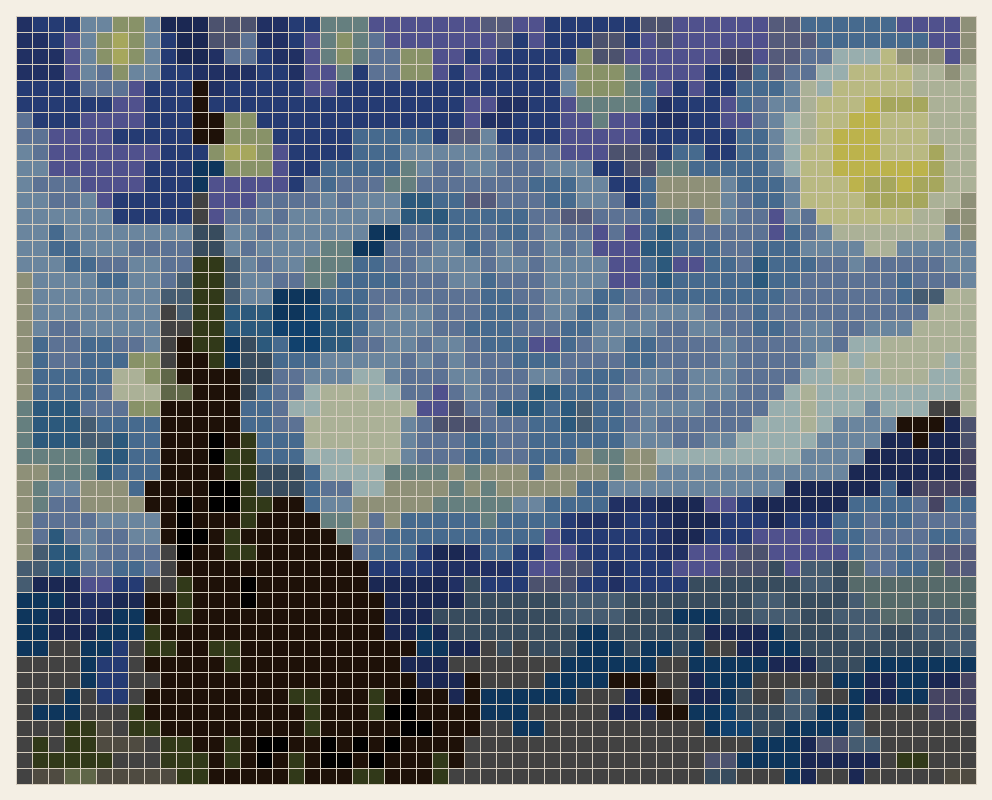
The Starry Night is a popular first choice: 30 colors, but the swirls make it easy to see where you are.
Organize the thread before you start
With 30 colors, many differ only slightly. A little setup saves hours of confusion:
- Buy every color on the thread key. The skein count is already worked out for each one.
- Wind each skein onto a floss card or bobbin and write its DMC number and chart symbol on it.
- Keep the cards on a ring in the order of the thread key.
- Cut a short length of each color and tape it next to its symbol on a printed key, so you can compare shades by daylight.
Stitch in 10 × 10 blocks
The heavy lines on the chart divide it into blocks of 10 × 10 squares. Work one block at a time:
- Stitch all of one color in the block, then the next color, until the block is full.
- Mark the block off on the printed chart with a highlighter.
- Move to the block next door.
This keeps your place, stops long jumps of thread across the back, and shows real progress on a project that could otherwise feel endless.
Some stitchers go further with parking: when you finish a color in one block, bring the needle up where that color starts in the next block and leave it there, threaded and waiting. It is worth trying once you are comfortable with the basics.
Stitch the details first
Within a block, start with the small, distinctive things: an eye, a star, a white flower, a dark outline. They are easy to find on the chart and act as landmarks. The large background areas around them are then simple to fill.
The stitching tip on each painting's page says where to begin for that painting. On Klimt's The Kiss, for example, start with the black and silver rectangles on the robe and fill the gold around them.
Checking your work
Every few rows, compare what you have stitched with the chart. A missing stitch in a big area of one color is easy to fix now and hard to fix later. If a stitch is wrong, unpick it with the tip of the needle rather than cutting; cutting risks snipping the neighbors.
How long will it take?
A 120 × 90 pattern has about 10,800 stitches. Many stitchers manage 100 to 200 full stitches an hour, so plan on roughly 55 to 110 hours. At an hour a night, that is two to four months: about the time it takes to read a few long novels.
Want a painting that is not here?
If the painting is in the public domain, save a large image of it and open it in the pattern creator. Crop it to the part you want, choose the size and number of colors, and you get the same kind of chart, thread key and skein counts. Patterns up to 60 × 60 stitches are free; larger ones are a one-time $3.99 per pattern.
To read the chart, symbols and key, see how to read a cross stitch pattern.